How Low Will Sellers Go When Negotiating a Small SaaS Acquisition?
A practical guide to negotiating below the asking price on a small SaaS acquisition, setting offer limits, and using financial evidence to support your valuation.

The Asking Price Is an Opening Position
The asking price on a small SaaS listing can feel strangely official. A seller lists the business for $49,000, and your brain immediately treats that number like it was calculated by a team of investment bankers in a glass conference room. Usually, it was not. Sometimes it came from a marketplace valuation tool. Sometimes it came from a revenue multiple. Sometimes it came from the seller looking at competing listings and deciding their business deserved to be somewhere in the neighborhood. And sometimes it appears to have been selected through spiritual guidance. The important lesson is this: the listing price is an opening position, not necessarily the final price.
Two Negotiations That Moved Far Below Asking
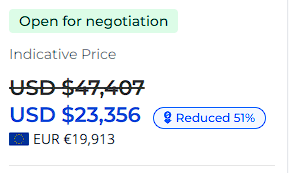
In two small SaaS negotiations I followed closely, one business originally carried a valuation around $47,000, was later discounted to roughly $23,000, and eventually reached an agreement at $16,000. Another business was listed around $49,000 and later reached an agreement near $25,000. That does not mean every seller will accept half of the asking price. It does mean buyers should not assume the listing price represents the lowest amount the seller would realistically take.
The Asking Price May Have Several Layers
A business can have more than one “price” before serious negotiations even begin. There may be:
- The original valuation
- The public listing price
- A temporary discounted price
- The seller’s verbal target
- The seller’s actual walk-away number
Those Prices Can Be Very Different
In one negotiation, the business had previously been associated with a price around $47,000. By the time the buyer became involved, the seller was already discussing a discounted range closer to $23,000. The eventual agreement was $16,000. That was roughly one-third of the original figure. If the buyer had treated $47,000 as untouchable, the conversation may never have started.
The Public Price May Not Be the Closing Price
In the second deal, the business was publicly listed for approximately $49,000. The seller later became willing to accept about $25,000. That is still a meaningful purchase price, but it is close to a 49% reduction from the listing. The public price and the price required to close the deal were not the same.
Why Sellers List Higher Than They Will Accept
There are several reasonable reasons sellers may start high.
- They expect buyers to negotiate
- They are emotionally attached to the business
- They are testing the market
- The listing may be old
- Their urgency may have changed
- They may simply be optimistic
Sellers Often Leave Room to Negotiate
If a seller wants $25,000, they may list at $35,000 or $40,000 because they assume buyers will make lower offers. Starting high gives them room to move without immediately falling below their target.
Emotional Attachment Can Affect Valuation
The seller built the product, found the customers, handled support, fixed bugs, and probably argued with Stripe at least once. That history can make the business feel more valuable to them than the financials suggest.
Motivation Can Change Over Time
A seller who was willing to wait six months for the right price may later decide they want to focus on another project and close quickly. Revenue may also have declined since the listing was published. A price that once felt reasonable may no longer reflect the current condition of the business.
Optimism Is Not a Valuation Method
There is no law against optimism. There is also no law requiring the buyer to finance it.
How Low Can You Actually Offer?
There is no universal percentage. You cannot automatically offer 50% below every listing and expect sellers to congratulate you on your financial discipline. The right offer depends on the evidence. A lower offer is easier to justify when:
- Revenue has declined
- Current MRR is lower than the listing claims
- Profit is unstable
- The codebase needs major work
- The business depends heavily on the owner
- Customer acquisition has stopped
- Churn is high
- The seller has struggled to find a buyer
- The business has been listed for a long time
- The buyer is offering a clean, fast transaction
Support the Offer With Evidence
The strongest negotiation position is not, “I want to pay less.” It is, “Based on the current financials and risks, this is the price that makes sense for me.” That turns the conversation from a random discount request into a valuation discussion.
Do Not Negotiate Against the Listing Price Alone
A common mistake is choosing an offer by subtracting a percentage from the seller’s price. The business is listed for $40,000, so you offer $30,000. Why? Because $30,000 is lower? That is not enough. You should build your offer from the business upward, not from the listing price downward. Look at:
- Current monthly profit
- Recent revenue trend
- Customer retention
- Owner workload
- Technical risk
- Transferability
- Growth requirements
- Your expected return
- The additional capital needed after closing
Build the Offer From Current Earnings
Suppose a SaaS produces $600 in monthly profit. At $40,000, you are paying more than five years of current profit before considering taxes, loan payments, technical repairs, or the possibility that customers leave. That price may not work. A $20,000 offer may sound aggressive compared with the listing, but it may be completely reasonable based on the current earnings.
The Seller’s Price Is an Opinion
The seller’s price is an opinion. Your offer should be math. Preferably math performed before you emotionally fall in love with the dashboard.
The First Offer Does Not Need to Be Your Maximum
Before negotiating, decide three numbers:
- Your opening offer
- Your target price
- Your maximum price
Know What Each Number Means
Your opening offer should leave room to move. Your target price is the number you believe represents a fair deal. Your maximum is where you stop. That last number matters because negotiations have a strange way of making buyers forget their own limits.
Do Not Let Negotiation Momentum Move Your Limit
You offer $15,000. The seller wants $25,000. You move to $18,000. They move to $23,000. You reach $20,000. At some point, you may start thinking, “It is only another $2,000.” Then another $2,000. Then perhaps you should raise the offer one more time because you have already spent three weeks reviewing the business. That is how sunk cost walks into the negotiation wearing a name tag that says “flexibility.” Set the maximum before the conversation becomes emotional.
A Lower Offer Must Still Be Respectful
There is a difference between making a low offer and insulting the seller. A message like this is usually more effective: “After reviewing the current revenue, profit trend, customer base, and technical work required, I would be comfortable at $16,000. I understand that is below your current target, but it reflects the risk and additional investment I would need to take on after closing.”
Explain the Offer Without Attacking the Business
That message explains the offer. It does not tell the seller their business is terrible. It does not say, “This is all it is worth.” It says the price works for this buyer based on the available information. The seller can accept, reject, or counter. That is negotiation.
The Goal Is Not to Win an Argument
The goal is not to win an argument. The goal is to find out whether there is a price where both sides are willing to close.
Why Clean Terms Can Help Lower the Price
Price is not the only thing a seller values. Some sellers care about:
- Speed
- Certainty
- Cash upfront
- A simple asset transfer
- Limited transition requirements
- Fewer contingencies
- Avoiding a long financing process
A Simple Transaction Can Be More Valuable
A buyer may be able to negotiate a lower price by making the transaction easier. Helpful terms may include:
- A faster closing
- Clear diligence deadlines
- A reasonable transition period
- Fewer complicated payment terms
- Proof that the funds are available
- A straightforward letter of intent
Certainty Can Beat a Higher Offer
A $16,000 offer that can close cleanly may be more attractive than a $20,000 offer involving months of uncertainty, financing approvals, and seventeen creative contingencies. Higher is not always better if the higher offer has a strong chance of never closing.
When a Large Discount Is a Warning
A seller accepting a major reduction can create an attractive deal. It can also be a reason to slow down. Ask why the seller is willing to move so far. Possible explanations include:
- They want a quick exit
- They have another company requiring attention
- The business has been listed for months
- Revenue has declined
- They are tired of operating it
- There are risks other buyers have already noticed
- The original price was unrealistic
Understand the Seller’s Motivation
A large discount does not automatically mean something is wrong. But it does mean you should understand the motivation. You do not want to celebrate negotiating 50% off and later discover that the seller was mostly excited to transfer a collapsing codebase to a new volunteer.
The Lesson
How low will a seller go? Sometimes only a few percent below asking. Sometimes 20%. Sometimes nearly half. And occasionally, the final price may be roughly one-third of the original valuation. The answer depends on the seller’s motivation, the current condition of the business, the amount of buyer interest, and how well you can support your offer. Do not assume the asking price is final. Do not make a low offer with no explanation. And do not increase your offer simply because the seller started with a large number. Evaluate the business independently. Decide what the current revenue, profit, risks, and required work are worth to you. Then negotiate from that number. The seller is allowed to ask for the moon. You are allowed to remain on Earth.